
Metalwork · South India
Thanjavur Bronze: The Lost-Wax Gods of the Chola Country
In the temple towns of the Thanjavur country, hereditary sthapathis still cast gods in bronze by the lost-wax method the Cholas used a thousand years ago.
Home › South India › Wood & Furniture
Turned on a lathe and coloured with lacquer on the spin, Channapatna's wooden toys have delighted children for two centuries — and they are still safe enough to chew.
Channapatna is a small town in Ramanagara district, about sixty kilometres from Bengaluru on the road to Mysuru, and it has one claim to fame that fills its streets. It is Gombegala Ooru, the toy town of Karnataka, where workshops turn soft ivory wood into dolls, rattles, tops, pull-along animals and stacking rings, all finished in glossy lacquer. The toys are light, smooth and coloured in reds, yellows, greens and blues that seem to glow from inside the wood. That glow comes from lac-turnery, in which colour is melted onto spinning wood by friction alone, a technique practised here for more than two centuries.
The craft's history is told as a story of royal patronage. According to the town's artisans, it gained prominence in the late 18th century under Tipu Sultan, the ruler of Mysore, who invited Persian artisans to train local craftsmen in lacquer work. Historians still debate whether the technique arrived from Persia or grew from older local practice, since the materials are deeply indigenous to the region. The craft took root in Channapatna and stayed, passed down through families of turners. A later figure looms large in the town's own telling: Bavas Miyan, also called Bawa Saheb Miyan, is regarded as the father of Channapatna toys, and is credited with modernising the craft and introducing new techniques, including methods learned from Japanese doll-making.
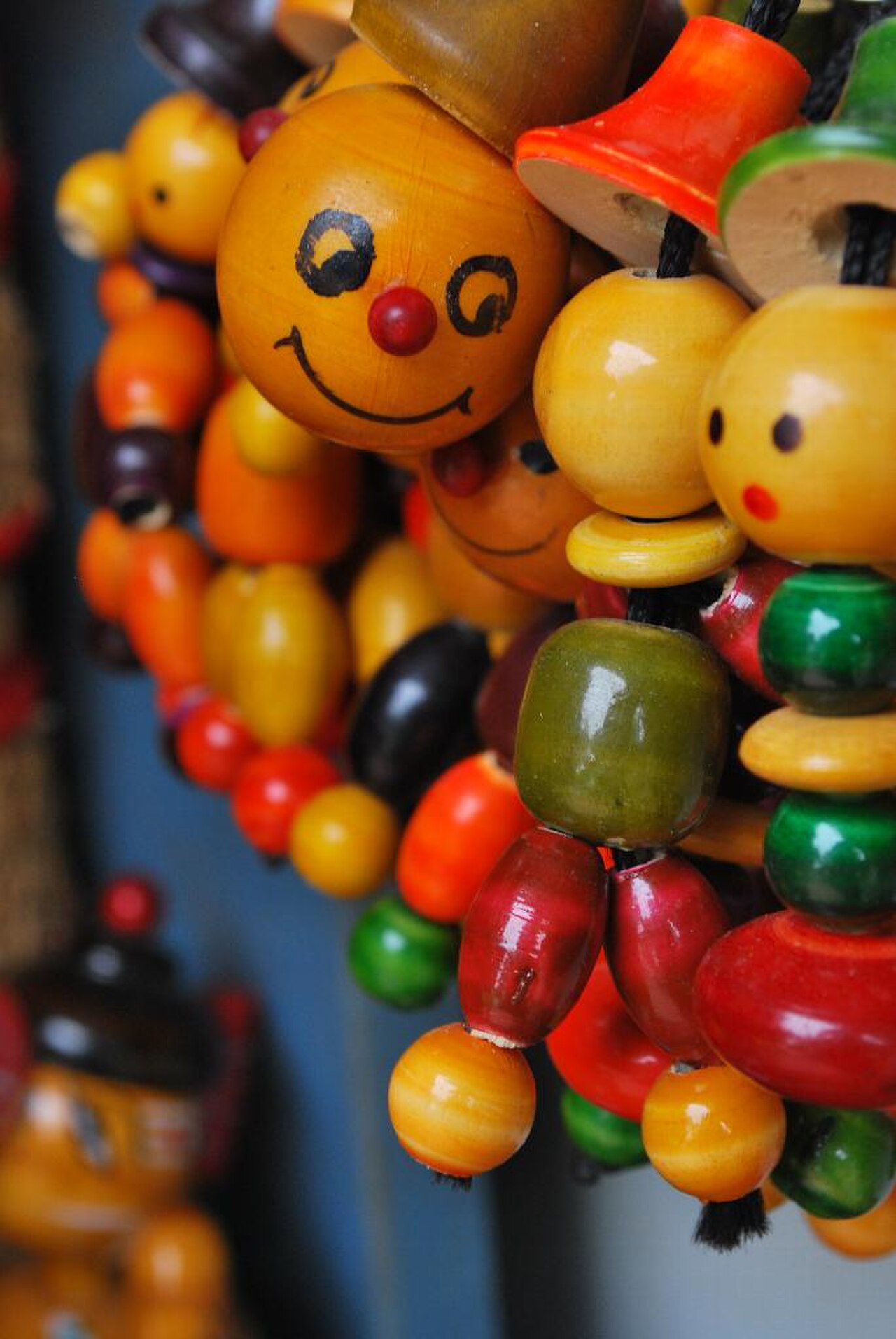
A Channapatna toy begins with the right wood. Traditionally it is the wood of the Wrightia tinctoria tree, known in Kannada as aale mara or hale mara, ivory wood, a soft, fine-grained, pale timber that turns cleanly on the lathe and does not splinter. The wood is seasoned, dried for weeks to months, so that it will not warp or crack after it is shaped. As ivory wood has grown scarcer, artisans have also begun using other soft, locally available woods such as rubber wood, cedar and teak. The second defining material is lac, known in Kannada as aragu, a natural resin secreted by the lac insect, which arrives as hard chips from West Bengal and Maharashtra. The colour comes from natural dyes: turmeric for yellow, indigo for blue and kumkum for red. The tools are simple: saws, adzes, lathes, cutting tools and dried screwpine leaves for polishing. There is no paint, no varnish and no adhesive in the traditional process, which is why the finished toys are considered safe for small children.
Making a Channapatna toy takes six stages, often handled by different craftspeople before the parts are assembled. First the coloured lac sticks are prepared. Lac chips are heated over a coal fire until they melt, dye is mixed into the liquid resin, and the coloured lac is cooled and cut into solid sticks. Meanwhile the seasoned ivory wood is cut into blocks and sized for the piece to be made. Then comes the turning. The block is mounted on a lathe, hand-operated or powered, and as it spins the artisan shapes it with chisels and files into spheres, cones, cylinders and other rounded forms. That is why so many of them are round, rolling, stackable things.

Before lacquering, the turned surface is buffed with a dried screwpine leaf, which smooths the wood without tearing its grain. Then comes the signature step. The piece is set spinning on the lathe again, and the artisan presses a coloured lac stick against it. The heat generated by friction melts the lac instantly, and it flows onto the wood in a thin, even coat. Further colours are applied the same way, and the artisan's control of pressure and speed decides how the colours meet and blend. After the lac is applied, the piece is buffed again, often with screwpine or palm leaf, to bring up the famous high-gloss finish, and if the design calls for it, fine lines are engraved into the lacquered surface. Finally the separate turned parts, a doll's head, a rattle's handle, the wheels of a pull toy, are assembled by hand into the finished object.

Channapatna toys are designed to be handled, and their design language follows from that. The forms are rounded and chunky, with no sharp edges, and the decoration is bold rather than fine: bands and rings of colour, dots, stripes and simple floral patterns laid down in lacquer. The best-known products are the figures of the Dasara doll tradition, the gombegalu displayed in homes during Navratri, along with animals, birds, dolls in local dress, spinning tops, rattles, xylophones, kitchen sets and pull toys. In recent decades the range has widened to include educational toys, stacking and sorting sets, bangles and jewellery boxes, all made by the same turning and lacquering method. The colours are the identity of the craft: bright natural dyes laid over pale wood so the grain still shows faintly through, sealed under a lacquer shine.


Channapatna toys are a GI-tagged craft. They received Geographical Indication protection in 2005, under the Geographical Indications of Goods Act, 1999, recognising that the toys' identity comes from the town of Channapatna and from the traditional lac-turnery process practised there. The tag means only toys made in the region by the traditional methods may legally be sold under the name Channapatna. The Karnataka State Handicrafts Development Corporation supports the craft through the Lacquerware Crafts Complex in Channapatna, a shared facility where artisans can use power lathes and other infrastructure.
A genuine Channapatna toy announces itself by its finish. The lacquer should be smooth, glossy and even, with the colour melted into the surface rather than painted on, and the wood grain should be faintly visible beneath it. Painted imitations look duller and flatter, and their colour sits on the surface and can chip or flake. The toy should feel light but solid, with rounded shapes and no rough edges or glue marks. Traditional colours have a warm, slightly muted quality, and the toy should have no chemical smell. Look for the GI logo, and buy from the Lacquerware Crafts Complex, the town's workshops, or the Cauvery Arts and Crafts Emporium. A plastic toy, or a wooden toy with a painted surface and a rough finish, is not a Channapatna toy, however bright its colours.

Channapatna's toy makers have had a hard few decades. From the late 20th century onwards, cheap mass-produced plastic toys, many of them imported, flooded Indian markets and undercut the town's handmade work, and many workshops closed or shrank. The GI tag, granted in 2005, protected the name but could not by itself protect the market, and the craft's survival has depended on finding buyers who value what plastic cannot offer: a toy made of natural materials, coloured with non-toxic dyes, that is safe for a teething child to chew. That positioning has worked better in recent years, as parents and schools have turned towards eco-friendly toys, and Channapatna toys now sell through government emporia and online stores far beyond Karnataka. The craft has even reached the White House: a Channapatna toy was gifted to Barack Obama, a moment the town still remembers. Today the town's family-run workshops keep turning ivory wood on their lathes, betting that a simple wooden toy, well made and honestly coloured, is worth more than a drawer full of plastic.

In the temple towns of the Thanjavur country, hereditary sthapathis still cast gods in bronze by the lost-wax method the Cholas used a thousand years ago.

Turned on a lathe, painted in tin and sealed in lac, Sankheda's maroon-and-gold furniture has carried a Gujarat village's name around the world since the nineteenth century.

In Saharanpur, at the foot of the Shivalik hills, generations of carvers have turned sheesham and teak into furniture that carries the city’s name around the world.