Thanjavur Bronze: The Lost-Wax Gods of the Chola Country
In the temple towns of the Thanjavur country, hereditary sthapathis still cast gods in bronze by the lost-wax method the Cholas used a thousand years ago.
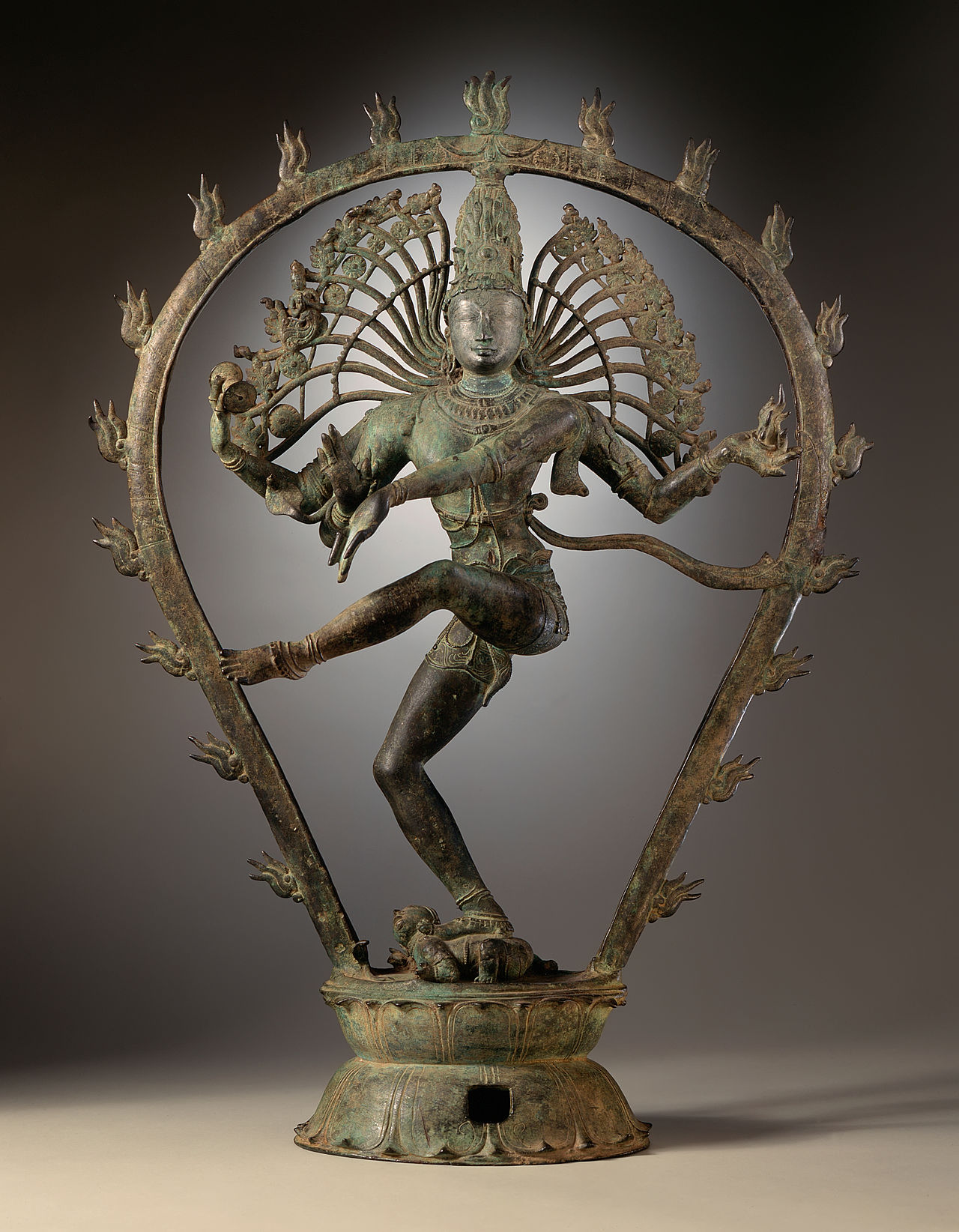
The bronze Nataraja, Shiva dancing inside a ring of flame with one foot raised and the other pressing down on the dwarf of ignorance, is the image by which Indian art is known almost everywhere, and the finest examples were cast in the Thanjavur country under the Cholas (ninth to thirteenth century). But the craft that made them never died. In Swamimalai, a small town on the Kaveri in Thanjavur district, hereditary sculptors known as sthapathis still cast bronze icons by the same method and proportions, for worship.
The story begins with the Brihadisvara Temple at Thanjavur, built by King Raja Raja I (985–1014). The king commissioned sculptors for the temple's iconography, and the metalworkers who answered stayed in the region. Later generations cast images for the twelfth-century Airavatesvara Temple at Darasuram, then settled at Swamimalai nearby. That settlement is why the living craft is concentrated in one town today. The Chola bronzes are no revived museum style. They are a continuous workshop tradition, carried by Vishwakarma families for something like a thousand years.
Lost-wax casting in progress at a Swamimalai workshop Rainer Halama, CC BY-SA 4.0
Materials: five metals, beeswax, and river clay
The metal of a traditional icon is panchaloha, the five-metal alloy of gold, silver, copper, zinc and lead. In practice the precious metals are present only in small quantities; the working alloy is mostly copper, with zinc to lower the melting point and give the figure its warm golden hue, and a little lead to ease the pour and the chasing. Contemporary workshops more commonly use bronze and brass alloys, reserving true panchaloha for pieces made to ritual specification. The exact mixture is part of the sthapathi's knowledge: the alloy determines the colour, the weight and the way the metal takes detail.
The model is wax — beeswax, kungiliyam resin and groundnut oil in a 4:4:1 ratio — and the mould is clay. Nothing here is exotic; the sophistication lies in what the hands do with ordinary materials.
The making: the lost-wax method, step by step
The technique is the lost-wax process, in Sanskrit madhuchishta vidhana, the beeswax method, and in French cire perdue. It is described in the Shilpa Shastras, the ancient treatises on icon-making, and has barely changed. The sthapathi begins by modelling the deity in wax, working entirely by hand and from knowledge: the proportions of every limb, the tilt of the head, the number of arms and what each hand holds are fixed by the Shilpa Shastra, and a figure that breaks those rules cannot be worshipped. For large images the wax model may be built hollow over a clay core, which lightens the finished statue; smaller figures are modelled solid.
A wax model being prepared for casting at Swamimalai Rainer Halama, CC BY-SA 4.0
Once the wax figure is finished, it is coated in layers of fine and coarse clay until a thick shell forms, with channels for wax to escape and metal to enter. The mould is heated, the wax melts and drains away, leaving a hollow cavity in the exact shape of the god. Molten bronze is poured in and left to cool. Then the clay is broken open — the mould destroyed to free the figure, so every casting is unique and the wax model is lost with it. The rough bronze is chiselled, filed and polished, and the eyes are often inlaid last, since the eyes give the image its presence. A detailed figure two to four feet tall can take three to five months.
Clay moulds prepared for bronze casting at Swamimalai Rainer Halama, CC BY-SA 4.0
Motifs and design language
The subjects of Thanjavur bronze are the gods of the Tamil temples, and the most celebrated is Nataraja, Shiva as the Lord of Dance, ringed by flame, his four arms holding drum and fire, one hand raised in blessing and one pointing to his raised foot. Around him stands the pantheon: Shiva with Parvati, Ganesha and Kartikeya, Vishnu, Rama, Krishna and the goddess. Many are utsava murti, processional icons carried out of the shrine on festival days, which is why they are cast in the round, balanced on a base and finished on every side.
The design language is governed by iconometry, the Shilpa Shastra measurements that fix each deity's proportions relative to the face as a unit. Within those rules the sthapathi has room for expression: the curve of a hip, the modelling of a face, the crispness of a flame halo. The best Chola bronzes are admired for this balance — absolute discipline in the canon, and within it, a lifelike grace that makes bronze seem to move.
An eleventh-century Chola bronze Nataraja in the Government Museum, Chennai Richard Mortel, CC BY 2.0
GI-tag status: a distinction worth making
There is no Geographical Indication called "Thanjavur bronze" — and it matters to say so, because two real GI tags in this region are easy to confuse with one. The first is Swamimalai Bronze Icons, registered in 2008–09 under application number 126, after the Tamil Nadu Handicrafts Development Corporation applied for protection in 2008. That tag covers bronze idols cast in Swamimalai itself by the traditional lost-wax method, and only icons made there may carry the name. The second is the Thanjavur Art Plate, a separate GI entirely, covering round plates, trays and vessels made by beating designs out of copper and silver sheets and encrusting them on brass — a different craft with different makers. The bronze icons of the Thanjavur country are therefore GI-protected in their Swamimalai form, but "Thanjavur bronze" as a general name is not a registered GI. This article uses "Thanjavur bronze" for the wider tradition and names Swamimalai where the GI tag applies.
Shiva as the Lord of Dance, a Chola bronze in the Los Angeles County Museum of Art Los Angeles County Museum of Art, Public domain
How to identify an authentic piece
A genuine Swamimalai icon shows the marks of its making: fine hand chasing — the file and chisel work of the finishing stage — rather than the smooth, slightly soft surface of a mould-made replica, and crisp detail: fingers, jewellery, the flame tips of a Nataraja's halo all sharply defined. A real lost-wax casting is a single pour, so the figure is one piece, not assembled from parts, and it has the satisfying weight of solid bronze. Look for the GI mark and the maker's name, and buy from the sthapathi workshops or the state handicrafts emporium, Poompuhar, which sources directly from them. Be wary of icons sold far from Tamil Nadu with no provenance: the market is full of mould-made copies and resin figures passed off as panchaloha. A real icon reflects months of a master sculptor's work; a large, finely finished Nataraja offered cheaply is almost certainly not what it claims to be.
Bronze statues in the art gallery at Thanjavur Richard Mortel, CC BY 2.0
Where the craft stands today
About 1,200 people in Swamimalai are involved in metal sculpting, and the town remains the only place where this tradition has continued without interruption since the Chola period. Its masters hold national awards and the Padma Shri, and have executed monumental Natarajas for institutions in India and abroad. Chola bronzes are among the most sought-after Indian sculptures worldwide, and that prestige feeds workshops supplying temples, collectors and devotees across the world. The pressures are real: metal prices, the long training a sthapathi needs, the temptation for young people to leave a demanding hereditary trade, and competition from machine-made copies. The craft's defences are its GI tag, the state emporia, and a market that still values the real thing: temples that need icons made to the texts, and collectors who can tell hand-chased bronze from a mould. A thousand years after Raja Raja's sculptors set up their furnaces here, the wax is still modelled by hand, the clay still broken to free the god, and the god still dances.
A 4,500-Year-Old Bronze Technique Is Still Practiced Today — The Craft Behind India’s Natarajas Watch on YouTube →Casting a Metal Statue, Swamimalai Watch on YouTube →
In Mysuru, artisans cut pictures into dark rosewood and fill them with ivory, pearl and coloured wood — a royal craft, known locally as Kundana Kale, that still glows after two centuries.
Woven in a temple town from three-ply mulberry silk and real gold zari, the Kanchipuram sari is South India's bridal cloth — and one of India's first GI-tagged crafts.