
Metalwork · South India
Thanjavur Bronze: The Lost-Wax Gods of the Chola Country
In the temple towns of the Thanjavur country, hereditary sthapathis still cast gods in bronze by the lost-wax method the Cholas used a thousand years ago.
Home › South India › Metalwork
Silver inlaid on metal blackened with soil from Bidar Fort — Bidriware is the Deccan's most dramatic craft, and one of its most endangered.
Hold a piece of Bidriware up to the light and the first thing you notice is the contrast: a matte black body crossed by a tracery of bright silver so fine it looks drawn rather than made. Vases, hookah bases, trays and jewellery boxes all carry the same signature. Bidriware takes its name from Bidar, in northern Karnataka, its centre of production for six centuries, and its secret is that the black is not paint or enamel at all. It is the metal itself, darkened by a paste made from soil found only around Bidar Fort.
Bidriware developed in the 14th century, during the rule of the Bahmani Sultans, who made Bidar their capital. Persian metalworkers, whose traditions of inlaying precious metal into darker alloys were already old, worked alongside local craftsmen, and the result was a new idiom: Persian arabesques and geometric patterns executed in silver on a zinc alloy that could be turned black. Bidar remained the centre of the craft through the Barid Shahis, the Mughals and the Nizams of Hyderabad. A 17th-century ewer in the Victoria and Albert Museum shows how far its reputation travelled.

Bidriware begins with an alloy that is unusual in itself: zinc and copper in the ratio of roughly sixteen parts zinc to one part copper, cast into the shape of the object. The high zinc content is what makes the whole craft possible, since zinc darkens readily when oxidised, while copper gives the alloy enough strength to be cast and worked. The inlay is pure silver, used as fine wire or thin flattened strips and sheets. Historic pieces sometimes used gold or brass, but silver on black is the classic combination. The other essential material is not a metal at all: a particular soil, found only in the unlit portions of Bidar Fort, which artisans say has oxidising properties that ordinary soil does not. The workshop also keeps ammonium chloride, copper sulphate, castor oil, resin and finishing oil: two metals, a fort's soil, and a handful of salts and oils.
Making Bidriware is an eight-stage process, and in a traditional workshop it is a relay: different artisans specialise in different stages, and a piece passes from hand to hand over a day or more. First, a mould is formed from soil made malleable with castor oil and resin, taking the impression of a master model. Molten zinc-copper alloy is poured in and left to cool, and the rough casting is smoothed by filing. Next the surface is coated with a strong solution of copper sulphate, which gives it a temporary black layer, and the design is drawn freehand on this dark ground with a metal stylus, so the craftsman can see the lines clearly.
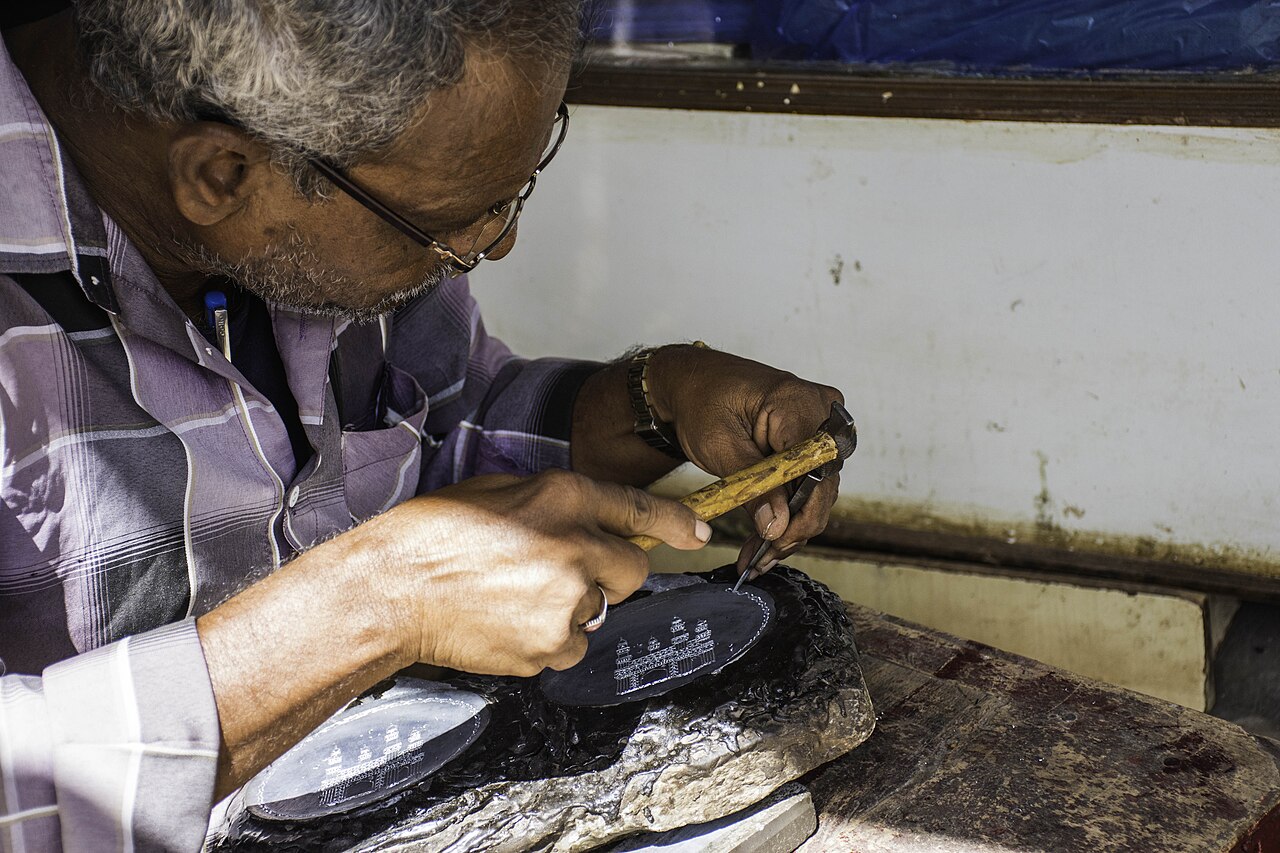
The piece is then secured in a vice and the design engraved with small chisels, cutting grooves along the drawn lines. Fine silver wire or flattened strips are hammered into these grooves until they sit flush. The piece is filed, buffed and smoothed again to remove the temporary black coating. Then comes the stage that gives Bidriware its identity. The Bidar Fort soil is mixed with ammonium chloride and water into a paste and rubbed onto the heated surface, or the piece is dipped into a heated solution of the same mixture. The paste selectively oxidises the zinc alloy, turning it a deep matte black, while leaving the silver untouched. It is rinsed off to reveal the silver gleaming against the black, and the piece is rubbed with oil to deepen the black and protect the surface. No paint has touched it at any point.
The inlay takes several forms. In tarkashi, fine silver wire is laid into engraved lines; in teh nashin, flat silver sheet is set flush into deeply engraved surfaces; in zar buland, the silver stands in low relief above the surface; and in aftabi, the silver is applied over a blackened background so the pattern reads in the positive. A single piece may combine more than one of these techniques.
Bidriware's designs carry the history of its making. The oldest vocabulary is Persian and Islamic: geometric lattices, arabesques of scrolling vine and leaf, stylised poppies and creepers, and panels of calligraphy, arranged with a formal symmetry that suits vases, surahis and hookah bases. Over the centuries the repertoire widened to include motifs from the Deccan itself: peacocks, elephants, lotus flowers and scenes from court and country life. The designs are drawn freehand, not stencilled, and a good piece shows it in the slight variation of its lines. Classic forms include the surahi, or wine decanter, the hookah base, the vase, the tray, the paan box and the jewellery box, and in recent decades artisans have adapted the same techniques to jewellery, lamp bases and small sculptures.


Bidriware is a GI-tagged craft. It was registered under the Geographical Indications of Goods Act, 1999, on 3 January 2006, as GI number 21, recognising the craft's long association with Bidar and its distinctive blackening process. The tag means only ware made in the Bidar region by the traditional process may legally be sold as Bidriware. The registration also records what makes the craft geographically specific: the black finish depends on soil from Bidar Fort, so the craft cannot simply be relocated, and the soil's supply is limited.
The most reliable sign of genuine Bidriware is the black itself. On a real piece the black is the oxidised alloy itself, with a matte, slightly metallic depth, not a coating on top of it. Painted imitations look glossier, and their black can chip at the edges to reveal bright metal. Next, look at the silver. On an authentic piece the inlay sits flush with the surface, or in deliberate low relief, hammered into engraved grooves, so it cannot be picked at or peeled away. On fakes the silver is often thin foil glued or pasted on, and its edges lift. The design should be crisp, with fine, even lines, and the piece should feel dense and weighty. Finally, look for the GI tag or GI logo on the packaging, and buy from a reputable source: the artisans' own workshops in Bidar, the Karnataka State Handicrafts Development Corporation's Cauvery emporia, or an established government handicraft outlet.

Bidriware survives, but under pressure: the number of practising artisans in Bidar has fallen as young people leave for steadier work and the price of silver rises. Cheap imitations, often painted metal with pasted foil, undercut genuine work, and many buyers cannot tell the difference. The workshops that remain are concentrated in Bidar, with a smaller historic presence in Hyderabad, where Bidri artisans were once invited to work for the Nizam. Against that, the GI tag gives the craft legal protection it did not have before 2006, and government emporia, craft exhibitions and online sales have given Bidar's artisans a wider market. The most encouraging recent development is the move into jewellery and smaller, more affordable pieces, which has brought Bidriware to buyers who would never have bought a large vase or hookah. Whether that is enough will depend on whether buyers learn to recognise the real thing, and whether the next generation sees a future in the eight-stage process their grandfathers practised.

In the temple towns of the Thanjavur country, hereditary sthapathis still cast gods in bronze by the lost-wax method the Cholas used a thousand years ago.

In Mysuru, artisans cut pictures into dark rosewood and fill them with ivory, pearl and coloured wood — a royal craft, known locally as Kundana Kale, that still glows after two centuries.

In Moradabad, sand from the Ramganga, fire, and a hand-held chisel turn plain brass into engraved work the world has bought for four centuries.